
This text is part of a trilogy on design, AI, and narrative:
Creating an AI to Slow Down in a World Obsessed with Performance
Why I Built Amia(you are here)
I Built a Wellness AI. Then I Realized Metrics Lie About What Matters
The Hidden Cost of Metrics
The Risks of Doing What’s Necessary
Design in the age of language interfaces (you are here)
My best conversations always happened in the same place: my living room. My mother was a psychoanalyst. When I came home from school or college, I would find her there. Sometimes sitting on the sofa, sometimes on the chair opposite me. I would put on some music, grab a book, and the ritual would begin.
She always started with the basics: "How was your day?" We talked about us. Then, we moved on to facts, events. But the magic happened when we climbed the final step. The conversation left the "I" and the "facts" behind and entered the realm of Ideas. Philosophy, virtues, myths, archetypes. We spoke of God in absence and in presence.
It was a moment of intellectual nakedness. Intimate. Two souls connecting until nightfall.

My mother is gone now. And with her, that physical space of absolute listening is gone too.
I have no illusions: recreating that space is impossible. There is a sacred element in the biological presence of another human being that no line of code will ever replicate. Trying to imitate that would be creating a cheap forgery.
But from that absence, a different question was born: If I cannot (and should not) replicate the human, can I use technology to create a better mirror for our own consciousness?
Interface design as consciousness design
Twelve years leading strategic design at Reino Studio taught me a hard truth: code can be technically perfect, but if the interface does not respect human vulnerability, the product fails. Design is not just aesthetics; it is the removal of noise so the essential can appear.
I have always been fascinated by human-machine interaction, but designing Amia as a digital mirror presented a challenge of a different order: how do you design software that invites genuine introspection?
I am aware of the risks. Creating a space for digital immersion might sound like building an “Inverted Plato’s Cave”: not one you leave to see the truth, but one you enter to see shadows. Yet, everything worth creating involves risk.

My bet is that the future of AI belongs not to those with the best algorithm, but to those with the best context sensitivity. While the market fights to see who can make Excel run milliseconds faster — which has its value — I am trying to build the opposite.
I am designing a space of silence. Because personal evolution dismisses haste in exchange for the essential: the right design to allow us to stop, pause, and reflect.
The End of the “Blank Screen”: Curating Questions
The greatest enemy of depth in a chat is the blinking cursor. The “blank screen” intimidates. Often, we know we want to talk, but we don’t know where to start.
That’s why I made a controversial UX decision: Amia does not wait passively for your “Hi.” This inversion is intentional. If we left the beginning loose, we would fall into the trap of social autopilot. I wanted to ensure the very first contact was an invitation to dive deep.
There is an abysmal difference between “How was your day?” and “What made you feel alive today?” The first, you answer automatically. The second makes you stop. The second is a door.
There was enormous design work to refine these doors. When you open the app, you don’t find an empty chat. You find a deck of reflections. Visual cards, with a dreamlike aesthetic, that you can explore until you find the right question for your moment.
- “Do you feel comfortable with who you are?”
- “What old pain teaches you something valuable today?”
- “Do you prefer practical or philosophical conversations?”
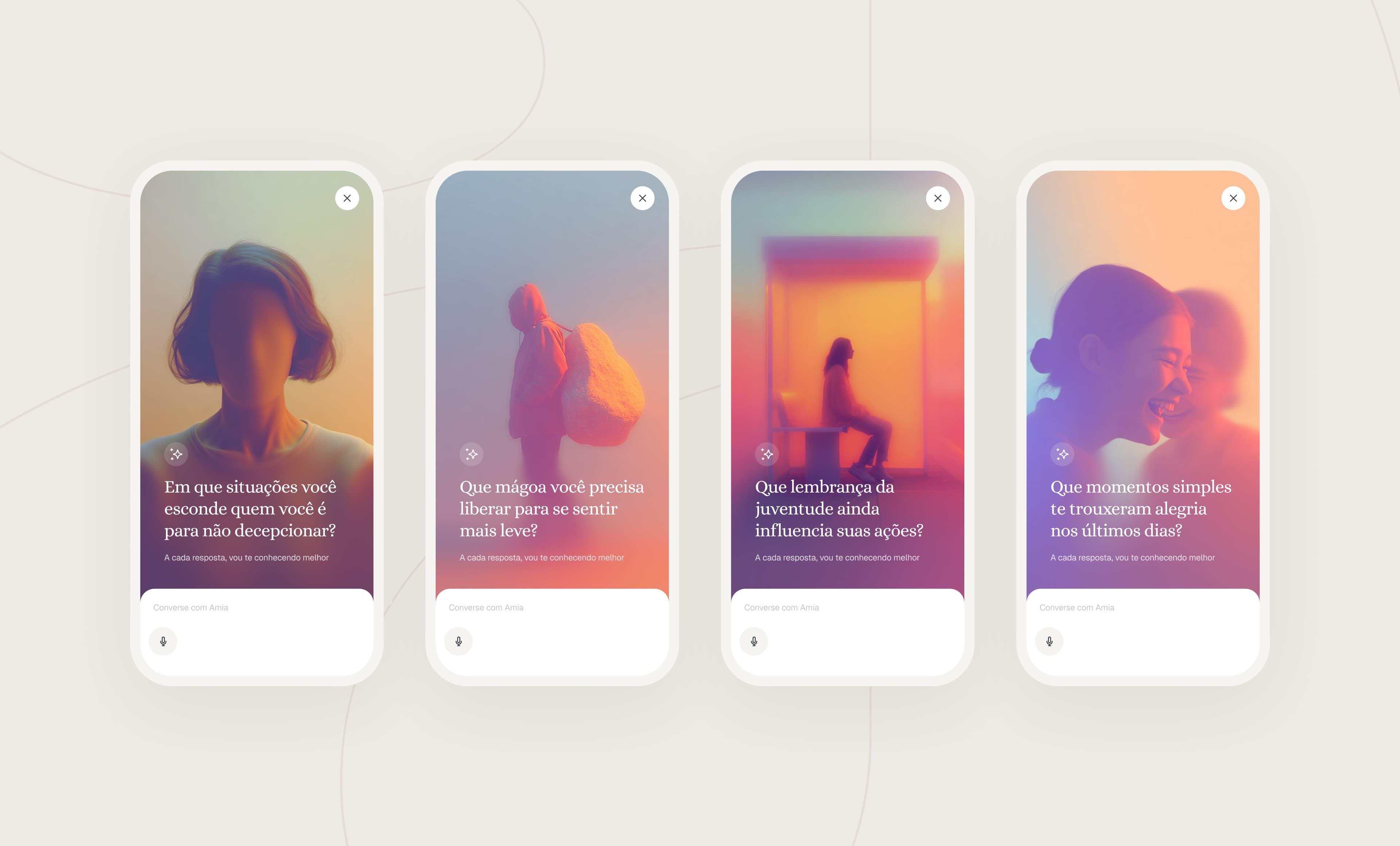
This interface was designed to elevate the level of conversation before it even begins. I know it’s a gamble: sacrificing the banal naturalness of a common chat in exchange for a high-level entry. By choosing a card, you enter the conversation “warmed up,” skipping the superficiality and going straight to the point of contact with your internal question.
The aesthetic of the unconscious: between minimalism and the dream
When designing Amia’s interface, I analyzed the three aesthetics that dominate the AI landscape. All have indisputable visual and conceptual merits, but they serve different purposes than ours.
There is Technological Futurism, with its neons and 3D avatars. It is a powerful aesthetic that celebrates data processing and science fiction. It is the visual of the “omnipotent machine.”
There is Utilitarian Minimalism, the famous “black background and white text.” As a designer, I deeply admire this school. It is the rigorous exercise of form follows function, seeking only the essential. For productivity and code, it is the perfect choice.
And there is Humanistic Simulation, with vernacular interfaces (a counter-culture movement to corporate perfectionism), seeking warmth through hand-drawn illustrations and organic visual elements. It is an aesthetic that attempts to emulate nature and friendship to reduce friction.
I respect all three paths. But for the universe of imagination and consciousness, I felt that absolute functionality was not enough.
Reflecting is not just processing data quickly (Futurism), nor just executing a task (Minimalism), and it is not always about comfort (Humanistic Simulation). Reflection requires atmosphere.
That is why Amia’s visual identity seeks the Oneiric. The universe of dreams.
I used image generation tools to create visuals that evoke the fluidity of the mind: silhouettes forming in the mist, dawn lights, paths that emerge and disappear.

The colors are not vibrant to grab attention (dopamine); they are soft gradients to soothe. The visual needs to tell your brain: “This is not a command terminal. This is a safe place for your subjectivity.”
The Ethics of Depth: The Tier System
Depth requires safety. To build Amia, I needed to solve an ethical problem: how to ensure the AI is not invasive?
The answer was to design an Access Tier System.
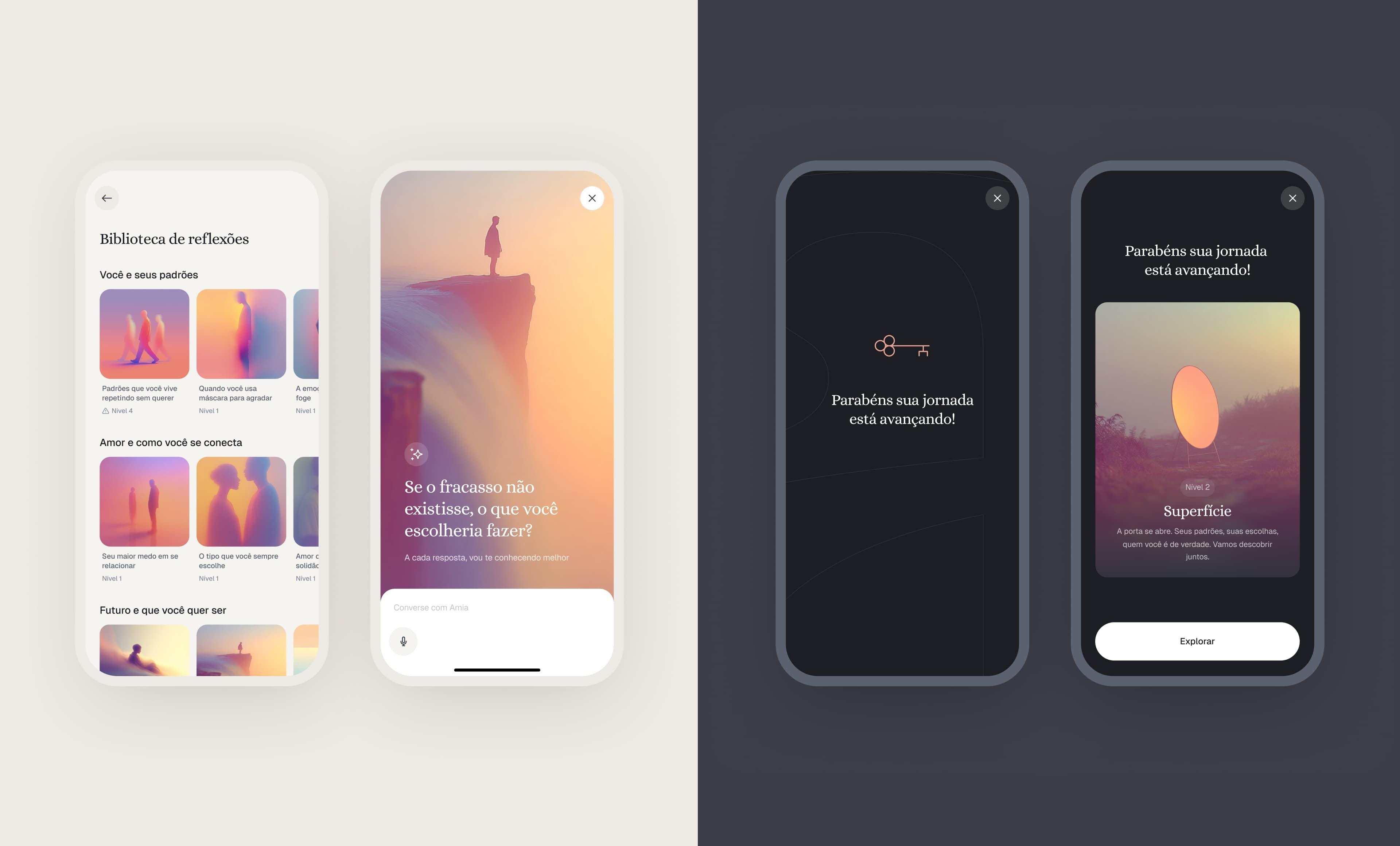
Even if you choose a deep card, Amia calibrates the response. Subsequent questions are divided into layers that unlock progressively, as the AI “gets to know” the user and perceives the openness to advance.
The last Tier is where the most sensitive issues reside — grief, pain, difficult memories. Here, the design changes. If the conversation touches on zones of real risk, the system interrupts algorithmic “curiosity” and offers, clearly and humanely, contacts for specialized professional help.
It is not just about creating a smart chat; it is about creating a safe digital environment.
The design of memory: “Notes About Me”
Talking is good, but seeing the conversation is what transforms. The biggest UX challenge in chat interfaces is that value gets lost in the infinite scroll.
To solve this, I designed the “Notes About Me” system in Amia. Imagine notebooks that the AI itself fills out while listening to you, organizing the chaos of your thoughts into clear structures:
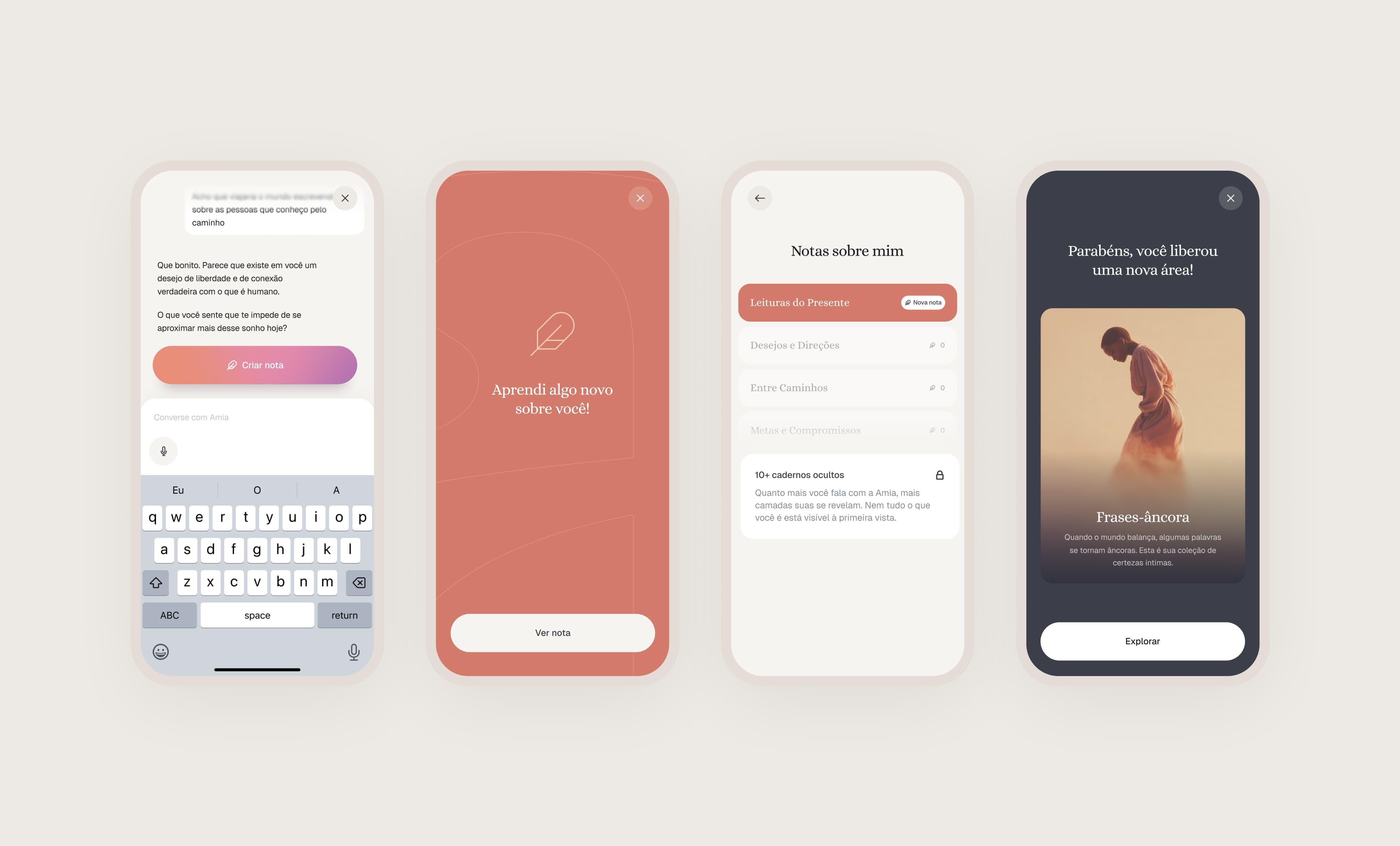
- Memories that Shape: Where we keep narratives from the past that still send “echoes” to your present.
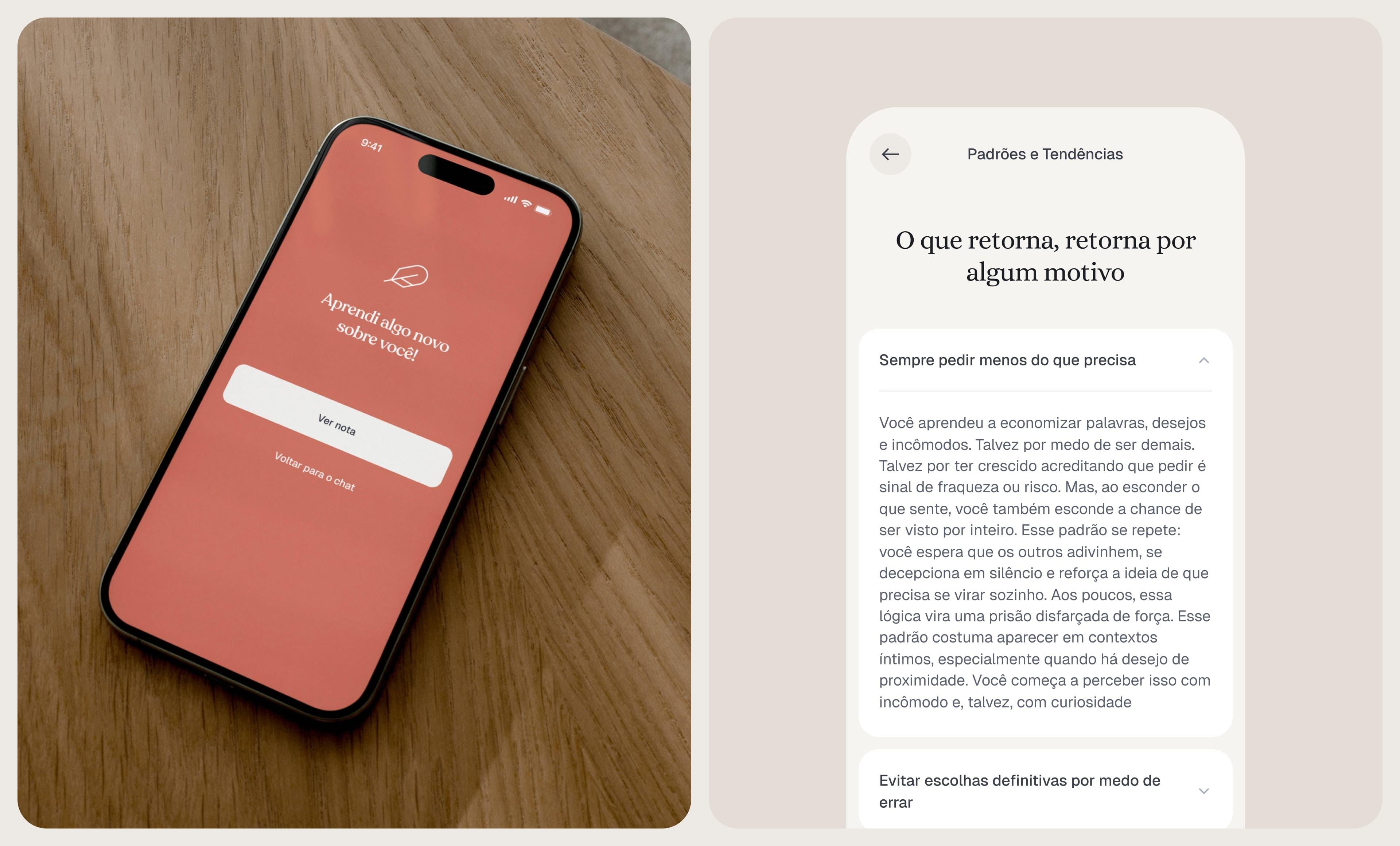
- Patterns and Trends: For when you repeat a behavior without seeing it. Amia notices the recurrence and suggests recording it.
- Desires and Directions: A space to separate impulse from life projects.
- Strengths and Fragilities: A map of your psychological capital and your blind spots.
There are many other notebooks, such as Anchor Phrases (for those truths we say without realizing) or Goals and Commitments. And the intention is to go further: in future versions, I want to map even subtler dimensions of the psyche. “Notes About Me” is not a dead archive; it is a territory in continuous expansion, designed to grow as our own complexity reveals itself.
A crucial detail of ethical design: these notebooks start locked and empty. Amia does not presume to know you. She earns the right to record something. Only when our conversation matures does she ask: “I think we have material to understand a pattern of yours. Shall we create a note?”
The Short Blanket Dilemma
Speaking of artificial “intelligence” requires a dose of technical humility. The backstage reality is arduous calibration work.
LLMs (Large Language Models) tend to “hallucinate,” invent facts, or lose the thread. To reduce hallucinations, we need to give the AI a lot of context (conversation history, notes, profile).
But here lies the “short blanket dilemma”: to have perfect context, token usage skyrockets. If token consumption skyrockets, the cost of interaction increases drastically, and performance drops.
We are discovering through testing where the delicate balance lies between an AI that “remembers everything” (but is slow and expensive) and an AI that is fluid (but might forget details).
Amia, like me, is still learning.

Why Brazil? A gap to bridge
The code is universal. I could have targeted the global market from the start. But I chose to focus on Brazil for a reason that blends strategy with a deep social urgency.
According to the World Health Organization (WHO), Brazil has some of the highest rates of anxiety in the world. However, access to high-quality psychological care remains a privilege. Coming from a family of psychoanalysts, I know firsthand that nothing replaces the clinical listening of a professional. The human bond in therapy is irreplaceable.
But I also know the math: in a country with deep economic inequalities, a weekly session with a therapist is financially impossible for the vast majority.
This creates a silent crisis: millions of people are navigating complex emotions alone, not because they don’t want help, but because they can’t afford the “gold standard” of human care.
That is where Amia comes in. We are not trying to replace the therapist. We are trying to fill the void of silence. We are building a tool for the “in-between” — accessible, immediate, and safe enough to start the journey of self-reflection.
My vision is to use Brazil as our learning ground. If we can build a system that provides genuine comfort in this high-stress, low-resource environment, we will have a model that can eventually serve the rest of the world.
Our roadmap is global, but our heart, and our starting line, is here.
An Invitation to Dialogue
That space in my mother’s living room is gone. But the need to listen to ourselves remains, more urgent than ever.
I am building Amia in public not just as a strategy, but as a confession: no human future is built alone.
Therefore, this is not just an invitation to join a waiting list. It is an invitation to those who want to participate in building a different kind of Artificial Intelligence.
I am open to complementary visions. If you are a researcher, creative, entrepreneur, or someone who sees paths I haven’t seen yet: the doors are open. I am looking for interlocutors who want to help design this ethics of digital care.
You can follow the visual behind-the-scenes, these fundamental stories, and the logbook of this process in our community on Instagram. There, I share stories, mistakes, design tests, and mostly the reflections that don’t fit into the code.
And if you want to experience Amia firsthand when she is ready, sign up below.
Whether as a user or as a vision partner: I would love to have your company on this journey.

To continue the dialogue
Thank you for accompanying me in this reflection. This text is part of an ongoing investigation into design, AI, and narrative that overflows into practice at my studio and in the tools I build. If these ideas resonated, I’d love to continue the conversation.
Where to find me: Pedro Brêtas and pedro@reinostudio.com
Projects: Reino Studio and Fale com Amia
References and Inspirations:
- Anxiety in Brazil: Data from the World Health Organization (WHO) identifies Brazil as the country with the highest prevalence of anxiety disorders in the world. (Source: WHO)
- The Cave: Plato’s “Allegory of the Cave,” described in The Republic, addresses the distinction between reality and projected shadows.
- Form Follows Function: Modernist design principle attributed to architect Louis Sullivan, stating that the shape of an object should be based primarily on its intended function.
- Reino Studio: Strategic design studio led by the author. (Link)