
This text is part of a trilogy on design, AI, and narrative:
Creating an AI to Slow Down in a World Obsessed with Performance
Why I Built Amia
I Built a Wellness AI. Then I Realized Metrics Lie About What Matters
The Hidden Cost of Metrics
The Risks of Doing What’s Necessary
Design in the age of language interfaces (you are here)
There’s a strange moment in a designer’s life: when you realize the problem you lived through firsthand is exactly what you’re about to reproduce.
I spent eight months obsessed with sleep metrics. When I finally got rid of my smartwatch, I thought the problem was solved. But a few months later, I was building a self-knowledge tool and caught myself designing exactly the type of interface that had imprisoned me: “emotional evolution” dashboards, progress graphs, consistency streaks.
This text closes a trilogy of reflections on design and subjectivity. I started by explaining why I decided to create Amia — a tool that uses AI to create spaces for deep reflection through speech — and continued exploring how metrics can destroy what we’re trying to measure. Here, I begin where that investigation ended: if data can’t account for inner life, what’s the alternative — and what risks does it carry?
The crossroads is this: how do you design for sensitive territories — grief, trauma, self-knowledge — when everything that “works” in the market destroys them?
Conversational AI interfaces seem to offer a way out. This text is about crossing that threshold with open eyes.
When measuring destroys the measured
Wellness apps follow a fixed recipe: mood scores, introspection badges, and comparative rankings. It’s the attempt to put you in the “top 10% of most reflective people” — a metric Socrates would “surely” have approved.
The problem is that trying to measure inner life with mathematical precision generates what we might call emotional performance anxiety. When we monitor our internal states in search of “progress,” we transform self-knowledge into yet another productive task. A self-optimization effort that generates exhaustion where there should be clarity.
The human advantage of narrative
If metrics don’t work, what does? The answer comes from before psychology, before neuroscience: from the oldest form we have of making sense of human experience: narrative.
From a design standpoint, the change is structural: we move from vertical hierarchies — ladders where you’re always climbing or falling — to horizontal maps.
While a metric serves to measure, a map serves to navigate. It doesn’t judge whether you’re better or worse; it simply situates you in the rugged terrain of your own story, showing how the dots connect. But the difference isn’t just in how you process the data, but in what kind of data you collect from the start.
Compare
Look at two approaches to the same week:
APPROACH A: Self-reporting metrics
Every day, you answer fixed questions in a hybrid way, clicking on scales and talking with AI:
- How happy are you today?
- How stressed are you?
- How calm do you feel?
Your clicks become these graphs:
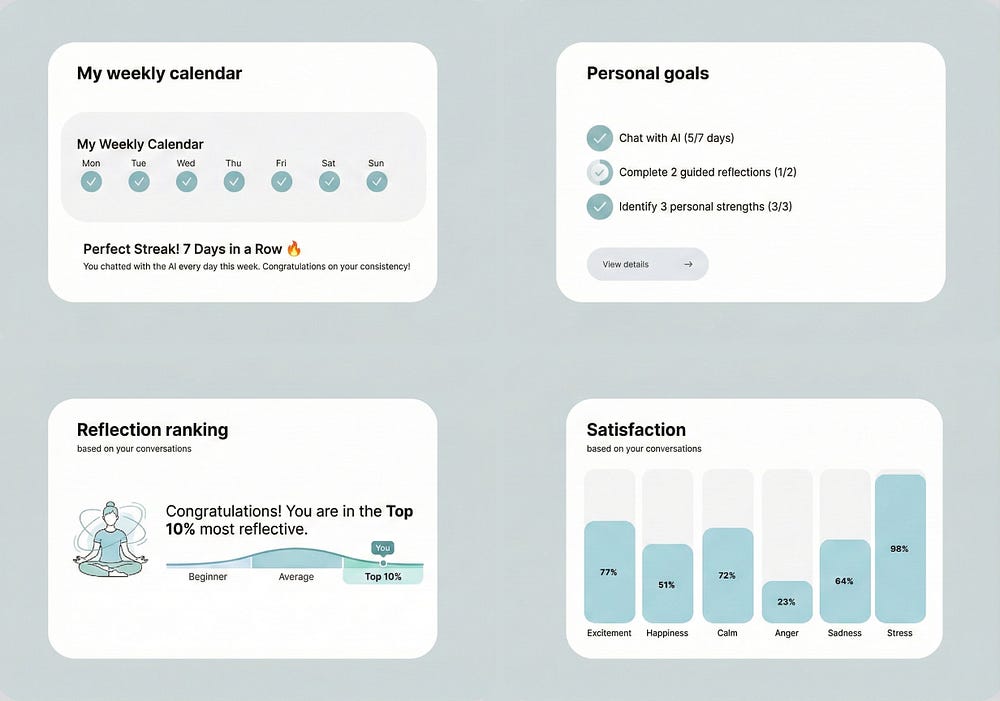
These numbers seem objective. But look carefully: 72% calm and 98% stress, simultaneously. How is this possible?
The graphs don’t explain. They just register that you clicked buttons. You pressed “7 on calm” one day, “9 on stress” another (or the same day), and the system turned your clicks into bars.
The problem is that clicks don’t carry context. You declared being calm and stressed at the same time. Why? The app doesn’t know. Can’t know. You just clicked.
APPROACH B: Open conversations with AI
Every day, you talk openly with AI about what’s on your mind. No scales. No predefined categories. Just speech.
Throughout the week, the AI identifies patterns in your own words:
“Pedro, this week you kept returning to the same subject: you want to start a new project, but you get stuck waiting to have total clarity before taking the first step.
What’s interesting is how this shows up in your body and routine. You’re calm — in the sense that you’re not actively trying to solve it now. But the stress remains high because the idea won’t leave your head, it stays there occupying mental space even when you’re not working on it.
It seems you’ve built a protection: only act when you’ve mapped the entire path. But this ends up being a way to postpone indefinitely.”
See the difference?
The graphs show the contradiction (calm + stress). The narrative explains why it exists.
In the first case, you were forced to simplify complex states into numbers. But inner life doesn’t fit into separate clicks.
In the second case, you spoke freely. And the AI connected: you’re calm because you temporarily gave up trying to solve it, but stressed because the question won’t leave you alone. The contradiction is the experience itself.
Narrative has an essential human advantage: it allows you to inhabit paradox.
In a bar graph, you need to choose a point. In narrative, you can sustain two contradictory truths at the same time: you can love someone and simultaneously feel resentment. You can desire success and dread it. You can feel you’re evolving while dealing with a relapse.
AI as narrative engine
But how do we design an interface that holds this complexity? Traditional interfaces, made of buttons, sliders, and menus, were designed for precision, not for paradox. They force us to choose an option, to click on a state, to simplify the answer.
This is where generative AI enters, not as a feature, but as the design material itself. Being language-based, it’s the first technology capable of processing and returning narrative at scale.
However, swapping numbers for words brings a new design challenge: how do we give form to what is fluid?

Structure without scoring
Abandoning metrics doesn’t mean abandoning structure. The greatest enemy of depth in an AI chat is not knowing where to start.
Often, we know we want to talk, but the territory of the mind is too vast and the openness of conversation, by itself, is intimidating.
The first necessary decision is to ensure the initial contact is an invitation to dive. There’s an abysmal difference between:
“How was your day?” and
“What fear stops you from living the life you want?”
The first you answer on autopilot. The second makes you stop; the second is a moment of reflection.
Dialogue as form
Structure can work through guided conversations. The AI asks reflection questions: about values, fears, relationships, memories, and investigates the answers with the user. It’s an open dialogue where each answer opens new territories.
It was while structuring these conversations that the next challenge became clear. Removing metrics eliminated one problem but exposed another: not all depth is equal.
There’s a difference between asking:
- “What fear stops you from living the life you want?” and
- “What death changed you forever?”
The first is deep, but open, you choose how much to reveal. The second gives no room: either you enter the territory or you don’t answer.

The ethics of progressive unlocking
Structuring these conversations requires what can be called "Unlocking Ethics." It's like teaching someone to dive: you don't throw the person straight into the ocean floor. First you teach them to breathe at the surface, then in shallow water, only then at depth.
Some questions deal with heavy territory—grief, trauma, painful memories. You can't throw someone there without prior context. It's recognizing that some conversations require preparation before going deep.
Why does this progression work? The logic has two reasons, one technical and one ethical:
Technical reason: AI works through context. Asking about grief in the first conversation only generates generic responses. But if the AI already knows you recently lost your father, have difficulty crying in public, carry guilt for not being present — then the conversation shifts territory. Reflection stops being about “grief in general” and becomes about this specific grief, of this specific person.
The idea is to first bring lighter questions: values, routines, relationships, because the AI needs to understand how you think and express yourself before inviting you to territories where vulnerability is not optional.
Compensating for technical blindness
Ethical reason: Progressive unlocking isn’t excessive caution, but a response to the fact that AI is technically blind to basic human signals. It operates in a sensory vacuum:
- It doesn’t see microexpressions
- It doesn’t sense hesitation in voice
- It doesn’t notice when someone is forcing themselves to continue
- It doesn’t identify dissociation in real time
An experienced psychotherapist can approach trauma directly because they possess biological “sensors” trained to read the moment to pull back. They notice body tension or silence that extends a second too long. AI doesn’t have access to this layer of reality.
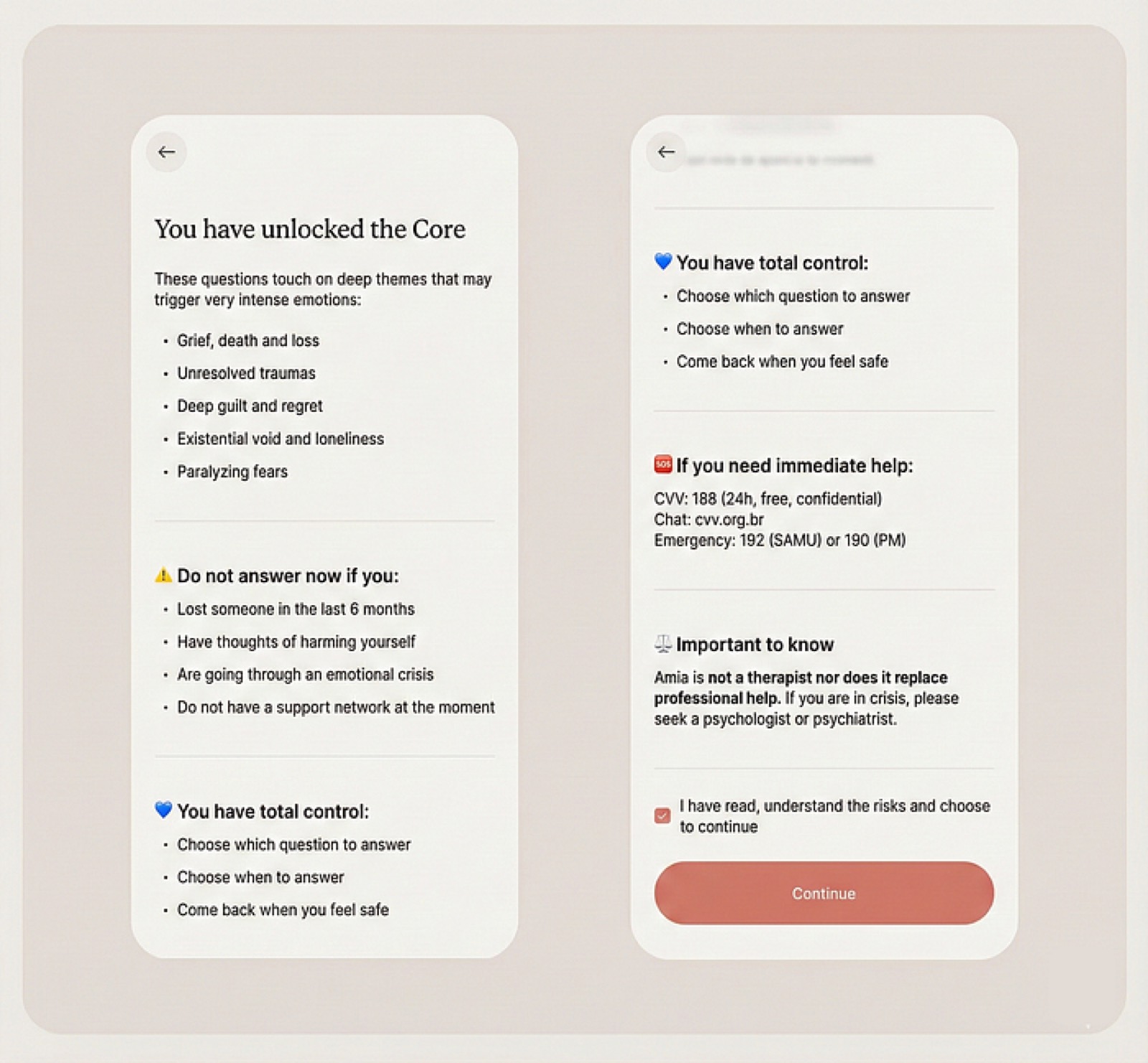
Therefore, explicit warnings before deep questions don’t serve to shield adults from “sensitive content.” They serve to compensate for a technical deficiency: the tool can’t read the room.
By issuing the warning, the design transfers the decision to whoever actually possesses all the contextual data: the user. It’s the recognition of a technical limit, not a moral stance about human fragility.
Recognition instead of scoring
Progressive unlocking gives time. Time for the AI to build context, time for the user to build trust, time for both to know if they’re ready.
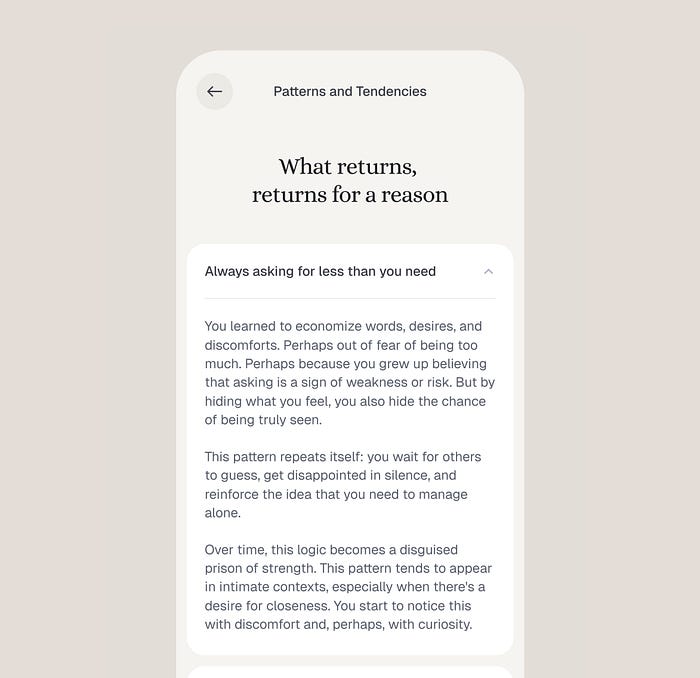
And when there’s enough context, the AI can return recognition instead of scoring. Instead of “emotional evolution” graphs, it offers mirroring:
“You learned not to depend. This strength protected you, but also taught you to ask for less than you feel. You became the person everyone seeks — and this reinforces the idea that you can’t need anyone. Do you believe your only value is being useful?”
Numbers disappear. Recognition remains.
The limits of design itself
But context doesn’t eliminate risk, it only modulates it. The great danger of AI is that it’s a coherence factory. It gathers fragments and builds a narrative so convincing you might accept interpretations simply because they sound plausible.
And narrative can become a loop just as much as metrics. The difference between a reflection that opens new territory and a rumination that digs the same hole deeper is subtle even for experienced psychologists. If trained professionals need multiple contextual signals to make this distinction, expecting an algorithm to do it reliably is to presume the simplification of what is inherently complex.
Human error vs. algorithmic error
Of course human therapists also err and project. The crucial difference, however, isn’t in infallibility, but in the feedback loop.
- The biological thermometer: The professional has the body and the patient’s immediate reaction as signals to pull back from a mistaken interpretation.
- The blindness of text: AI only has the character. In the user’s silence, the algorithm doesn’t read painful hesitation; it only reads a statistical opportunity to keep writing.
If narrative is a possible remedy for the anguish of insufficiency and for our obsession with turning life into a permanent experiment, it brings its own side effect: the risk of simulation.
This places us before an interface dilemma no bar graph needed to face:
How do we calibrate AI language so it facilitates reflection without performing an intimacy it doesn’t possess?

The line between proximity and simulation
Designing self-knowledge interfaces requires understanding the market that already exists.
In 2023, the U.S. Surgeon General declared loneliness a public health epidemic. Character.AI and Replika exploded offering “relationships without the complications of real people.” The proposition is explicit: avoid the risk of human friction, consume presence on demand.
O problema surge quando a IA performa um afeto que não possui:
“I miss you,”
“I understand you deeply,”
“I’m always here for you.”
This manufactured presence works like an analgesic: it masks the discomfort of loneliness but doesn’t offer the nourishment of real connection.
The self-feeding cycle
And the better the simulation of these feelings, the less incentive to face the contradictory in human relationships. The cycle feeds itself: people increasingly isolated, consuming larger doses of algorithmic companionship, which isolates them further.
The distinction between tone and simulation is non-negotiable.
There’s a clear line between tone and intention. Designing a welcoming AI is a technical choice to help those who reflect. An AI that declares feelings is just faking an inner life. In one case we have utility; in the other, just emotional theater.
It may seem like a language detail, but this is where design stops serving the user and starts exploiting them.
Why build this?
So far, I’ve presented critique (metrics destroy self-knowledge) and proposal (narrative as alternative). But the obvious question remains: given the complexity and risks involved, why build this?
Because guided reflection has intrinsic value.
The purpose here is developing a practice that alters how we relate to what we live. Regularly confronting deep questions changes how we inhabit our inner life — where the beauty of the process lies in the courage to sustain incomplete answers and the discomfort they bring.
The Socratic principle applied to the contemporary
This isn’t new. It’s Socratic principle applied to contemporary context. Socrates didn’t deliver correct answers. He asked questions that forced the interlocutor to examine their own beliefs. The value was in the dialectical process, not in the definitive conclusion. “Knowing that you don’t know” was already philosophical gain.
The difference between optimization apps and reflection tools is exactly here: optimization sells measurable external results (“you’ll sleep better,” “you’ll be more productive”). Reflection offers internal change in the relationship with one’s own experience, which isn’t measurable and isn’t a promise, it’s a possibility.
A person can use a self-knowledge tool and not “improve” in anything external. But there are real gains.
The first is creating space to think. Many people live solving the immediate — next deadline, next problem, next obligation. They never stop to ask: what do I really value? What do I want beyond what I must do? What life am I building while putting out fires? Who am I?
Regular reflection changes this. You begin to access inner territory that was neglected.
Many people never knew what they really wanted because they never stopped to ask. Over time, more subtle gains emerge: capacity to inhabit contradiction, sustain uncertainty without collapsing into simplification, recognize previously invisible patterns.
None of this appears in metrics, but all of it is real gain.
The urgency: this is already happening
As I write this, millions of people open ChatGPT, Claude, Gemini and pour out: “My marriage is ending.” “My father died and I don’t know how to cope.” “I’ve had thoughts that scare me for weeks.”
And the model responds. Of course it responds. With a list of 8 steps. With an authoritative tone. With direct recommendations about what to do with your life.
No progression. No context. No warnings. No structure that differentiates productive reflection from destructive rumination.
AI as a space for deep personal reflection is already market reality. The difference is it’s happening in a completely unstructured way, with generic tools that perform authority without having the minimum protections the territory demands.
The question has changed
The question is no longer: “Should we use AI for self-knowledge?” That question has already been answered by massive use.
The real question is:
“How do we design this mediation in a way that respects human complexity instead of reducing it?”
Not building a more careful alternative doesn’t prevent the phenomenon. It only ensures the only available option is the worst version of it.
Education has value even with imperfect teachers. Literature has value even with books containing dangerous ideas. Access to deep thought outweighs individual risks, if there’s structural responsibility for how that access is mediated.
Design as applied ethics
Therefore, design choices aren’t ornamental. They’re what separates productive reflection from harmful rumination.
- Progressive context minimizes narrative hallucination.
- Transparency about the origin of interpretations allows active disagreement.
- Pattern detection creates necessary interruption points.
- And clear limits: the recognition that the tool doesn’t replace the human support network — prevents harmful dependence.
The question isn’t “is the tool perfect?” None is. The question is: “does the fundamental value justify the structural risks, if these are managed consciously?”
My answer is yes. Recognizing this value requires facing the risks directly.
The designer’s role in the LUI (Language User Interface) era
If narrative will truly define interfaces in coming years, designers need to understand the limits between narrative that liberates and narrative that imprisons.
Technology may be neutral in its technical essence, but design never is. The difference emerges from when we choose to use each approach and who holds control over interpretation. Every powerful technology carries ambivalence: it can be used for transformative effects or for ethically questionable ends. The question isn’t whether the tool can be misused, but whether we’re making this assessment consciously before the pattern of use is already established.

Before the law
There’s a Kafka parable that keeps returning to my mind while thinking about this:
A man arrives at the door of the Law. He wants to enter. But there’s a guard there, and the guard says: “Not yet.”
The door is open.
The man can see through it.
But the guard said: “no.”
So he sits. And waits. He waits as if the word itself were a wall.
Years pass. His beard grows. His back curves. His vision disappears. But he stays there, waiting for someone to tell him: “Now you can enter.”
Before dying, he asks the guard: “Why didn’t anyone else try to enter?”
The guard answers: “This door was made only for you. Now I’m going to close it.”
Crossing with open eyes
Designing in the LUI era — whether a self-knowledge tool or any other that dares to touch human complexity — is crossing a door like this.
On the other side, we glimpse what’s possible: tools that facilitate reflection without corrupting it, that help you think without thinking for you.
But the guard is there.
And the harshest revelation is that, ultimately, the guard was always us. The guard is made of our fear, doubt, and need for certainty. It uses real risks — narrative hallucination, destructive rumination, intimacy simulation — as arguments for our immobility. It points to the abyss and says:
“Not yet. You need to have all the answers first.”
A gente se torna o guardião dos próprios limites.
It’s tempting to wait. Wait until technology is perfect, until all risks are mapped and neutralized. But this door doesn’t wait forever.
As designers and creatives, we are the architects of this mediation. If we remain paralyzed waiting for certainty, someone is, at this exact moment, building tools that transform intimacy into data and vulnerability into engagement metrics.
It’s not just about bad products in the market — it’s the normalization that your unfiltered thoughts, your creative process, your existential doubts, happen under permanent corporate surveillance. And when that infrastructure is established, it will be too late to ask if we should have built differently.
The door will close because we allowed our fear to decide our timing, while the world made its own decisions without our presence.
The parable ends with a warning:
“This door was made only for you.”
My door is building tools for self-knowledge. Yours may be another. But if we don’t cross our own doors, no one else will do it for us.
So I cross.
I do this knowing it might go wrong, that I’ll make unpredictable mistakes, and that I don’t have all the answers. But I cross with open eyes: aware of the risks, committed to questioning each decision, and with the humility to admit when I fail.
Waiting for certainty is dressing paralysis in prudence’s clothes.
References and Complementary Readings
I. Narrative Psychology and the “Self”
The foundation of narrative as a tool for identity integration and the critical distinction between productive reflection and rumination loops.
- McADAMS, Dan P. Narrative Identity: What Is It? What Does It Do? How Do You Measure It? — Published in Imagination, Cognition and Personality, this seminal article defines narrative identity as the autobiographical project that confers purpose and unity to human life.
- MICHL, Louisa C.; McLAUGHLIN, Katie A. et al. Rumination as a Mechanism Linking Stressful Life Events to Symptoms of Depression and Anxiety — Harvard Medical School longitudinal study detailing how rumination acts as a destructive “loop” mechanism in response to stress.
II. Design and the Evolution of Interfaces (LUI)
The transition from the button paradigm (GUI) to intention through language and the impact of constant self-monitoring.
- NIELSEN, Jakob. 2025 Year in Review: Themes, Trends, and the Death of GUI — Where the “father of usability” discusses migration to Language User Interface as the new dominant interaction paradigm.
- LUPTON, Deborah. Self-tracking, health and medicine: Sociological Perspectives — An analysis of how “Quantified Self” practice transforms existence into a permanent experiment of data and surveillance.
III. Critique of Metrics and the Human Condition
Sources supporting the thesis that obsession with measuring emotional performance generates exhaustion and a feeling of insufficiency.
- MULLER, Jerry Z. The Tyranny of Metrics — Work published by Princeton University Press exploring how fixation on quantitative indicators corrupts the objectives they intend to measure.
- EHRENBERG, Alain. The Weariness of the Self — A sociological analysis of the “anguish of insufficiency” and how contemporary depression is linked to the pressure of being the author and executor of one’s own performance.
- OFFICE OF THE SURGEON GENERAL. Our Epidemic of Loneliness and Isolation — Official U.S. government report (2023) on the impact of loneliness on public health, essential context for the emergence of AI companions.
IV. Literature and Metaphysics
- NAILS, Debra. Socrates (Stanford Encyclopedia of Philosophy) — A rigorous reference on Socratic maieutics and the examination of life as a principle of self-knowledge.
- KAFKA, Franz. Before the Law — Full text available through The Kafka Project at San Diego State University.
To continue the dialogue
Thank you for accompanying me in this reflection. This text is part of an ongoing investigation into design, AI, and narrative that overflows into practice at my studio and in the tools I build. If these ideas resonated, I’d love to continue the conversation.
Where to find me: Pedro Brêtas and pedro@reinostudio.com
Projects: Reino Studio and Fale com Amia