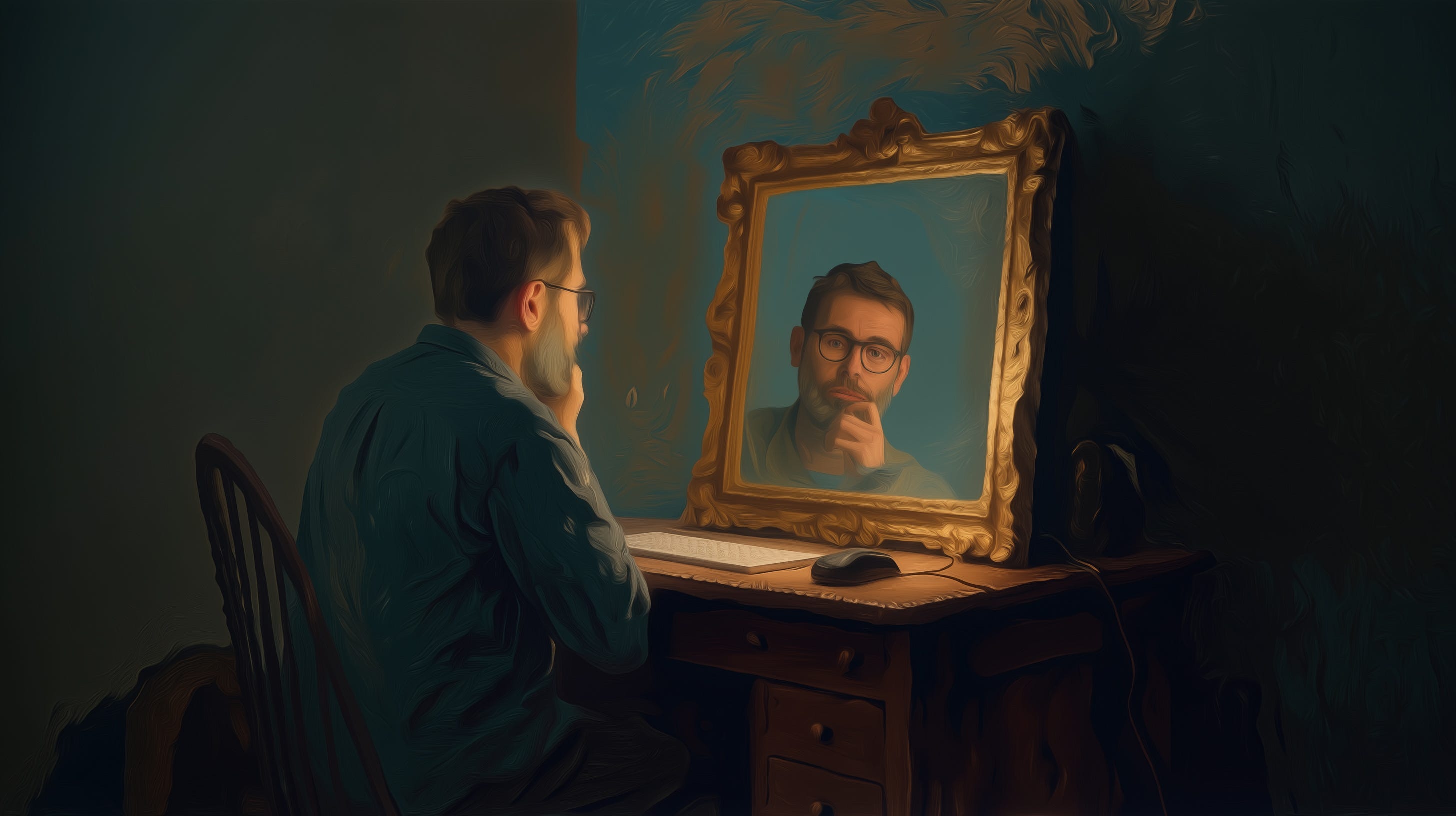
I've been thinking about vanity lately. Not the mirror-gazing, appearance-obsessed kind, but something deeper and more uncomfortable. The kind that lurks in the shadows of our creative work, our intellectual discussions, and even in our reluctance to expose ourselves to the world.
You know that moment when you’re absolutely convinced your design is brilliant, and then the client says, “Can we make the logo bigger?” Your soul dies a little, doesn’t it? Well, mine certainly has. More times than my ego wants to acknowledge.
The creative ego circus
As a designer and entrepreneur, I’ve had countless moments where vanity revealed itself in ways that made me cringe. There I was, forcing ideas that I found brilliant but clearly weren’t working. Engaging in unproductive discussions with clients, not to reach understanding, but to prove I was right. Getting defensive when showing a new concept and receiving criticism that felt like a personal attack. Because apparently, it was.
Here’s a question worth pondering: When was the last time you fought for an idea not because it was good, but because it was yours?
It’s funny how creation works. When you design something, you imprint a piece of yourself into it. The work becomes an extension of who you are. So when someone critiques your creation, it doesn’t feel like they’re questioning a design, it feels like they’re attacking your very essence.
But here’s what experience has taught me: collaborative creation is incredibly powerful. When ideas collide, they improve. They become clearer, simpler, more refined. Learning to deal with contradiction is both a professional development process and a lesson in humanity. We’re far from knowing everything, and there’s nothing better than another perspective to expand our own.
It’s fascinating how an idea that seemed solid in our heads dissolves like sugar in the rain when it needs to make sense to someone else.
The Frankenstein Syndrome
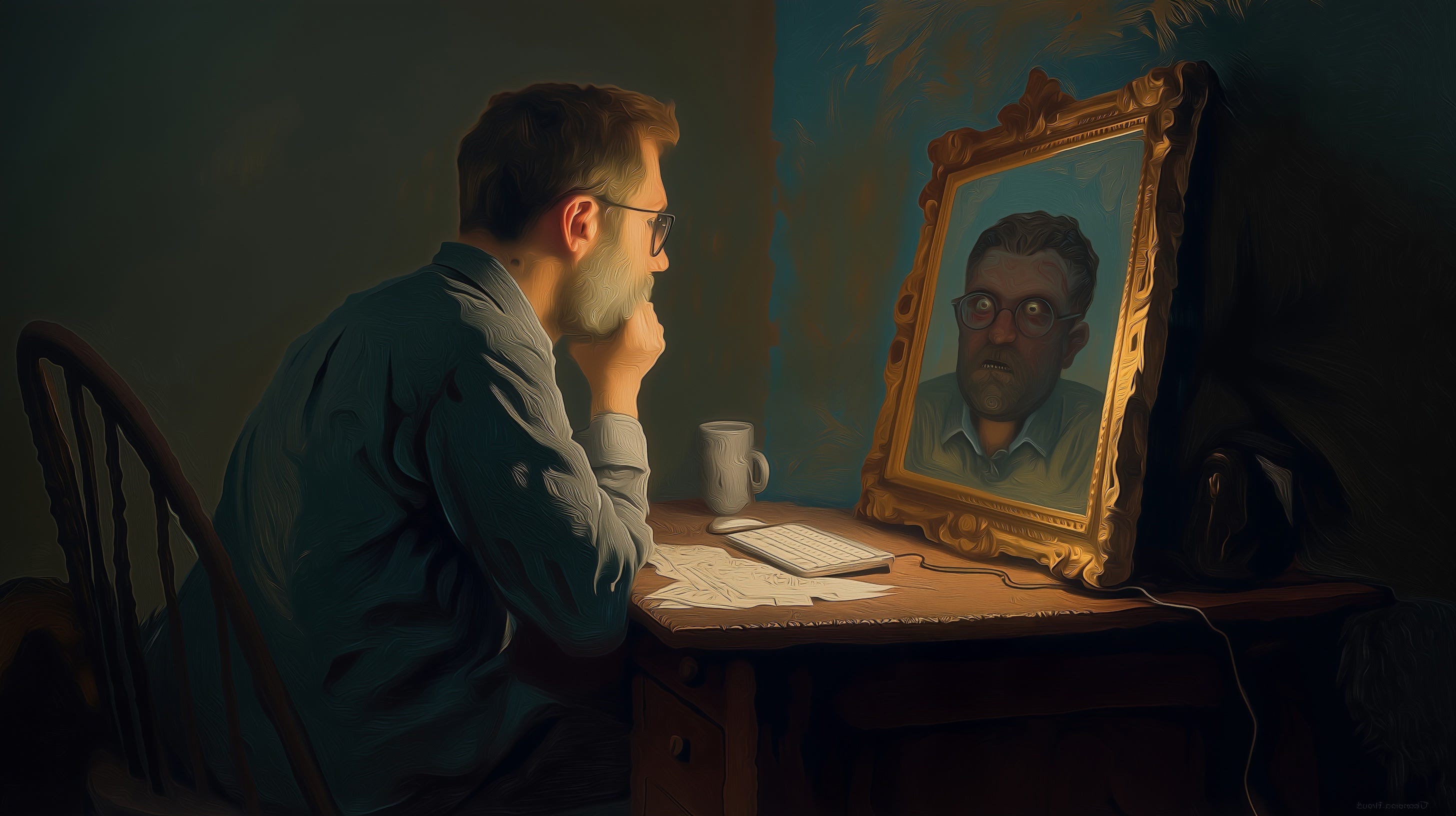
In design specifically, vanity shows up in multiple ways. You start believing your idea is superior, that your execution can’t be questioned, that your vision is unique and special, even when it’s evidently not. It’s a passionate love affair with our own creations. Not the kind of love that accepts reality with all its flaws and inconsistencies, but obsessive, blinding love.
It reminds me of Frankenstein, so intoxicated by his process that he was oblivious to the horror he was creating. I’ve found myself on the Frankenstein side with uncomfortable frequency. That’s why working together is so important, sharing responsibility, staying open to contradiction, to other perspectives that add value.
The worst part? Sometimes we know our “creation” isn’t perfect, but we’re so invested in being right that we can’t let go. We become prisoners of our own creative ego. Like a bad relationship you stay in just because you’ve already invested too much time to quit now.
Reflect on this: How many of your “masterpieces” were actually just elaborate monuments to your own stubbornness?
Intellectual sword fighting (or: how I learned to love being wrong)
Then there’s intellectual vanity, perhaps the most insidious kind. It can always be present, and often in the worst scenarios. In discussions with clients, the goal shifts from reaching agreement to seeing who wields language better. Who has greater control over words and knows how to use them like a sword. It becomes intellectual fencing.
Picture this scene: You’re in a meeting, and instead of listening to solve the problem, you’re mentally composing your next brilliant counterargument. Sound familiar? Welcome to the club of people who confuse eloquence with intelligence. We recognize each other by our monologues disguised as dialogue.
Sometimes this can be positive when the objective is reconciliation — understanding the other’s vision, finding convergence points, expanding our horizons with a different perspective. But often, that’s not what happens. We become so focused on responding to others with greater wit and cunning that we lose sight of the actual conversation. It becomes art for art’s sake. Pure sophistry.
I catch myself doing this and feel embarrassed. There I am, more concerned with sounding clever than actually solving problems or building bridges. It’s like explaining the physics of fire while the house is burning — impressive knowledge, but where’s the hose?
Ask yourself: In your last “intellectual discussion,” were you trying to understand or to impress?
The vanity of hiding (or: the coward’s guide to self-preservation)
Perhaps the most intimate form of vanity for me is the vanity of not exposing myself. I’m quite introspective by temperament. I spend a lot of time inside my own head, and it’s very comfortable there. The external world is terrifying; the judgmental gaze of others is anguishing.
I have a vision of myself that’s probably completely false, or at least partially so. The act of not exposing myself protects this self-perception. It’s a safe space where I can maintain the illusion of who I think I am.
But here’s the delicious irony: I think I’m protecting my ego by hiding, when actually I’m just feeding it a steady diet of unchallenged fantasies. It’s like living in a house of mirrors where every reflection confirms how brilliant we are.
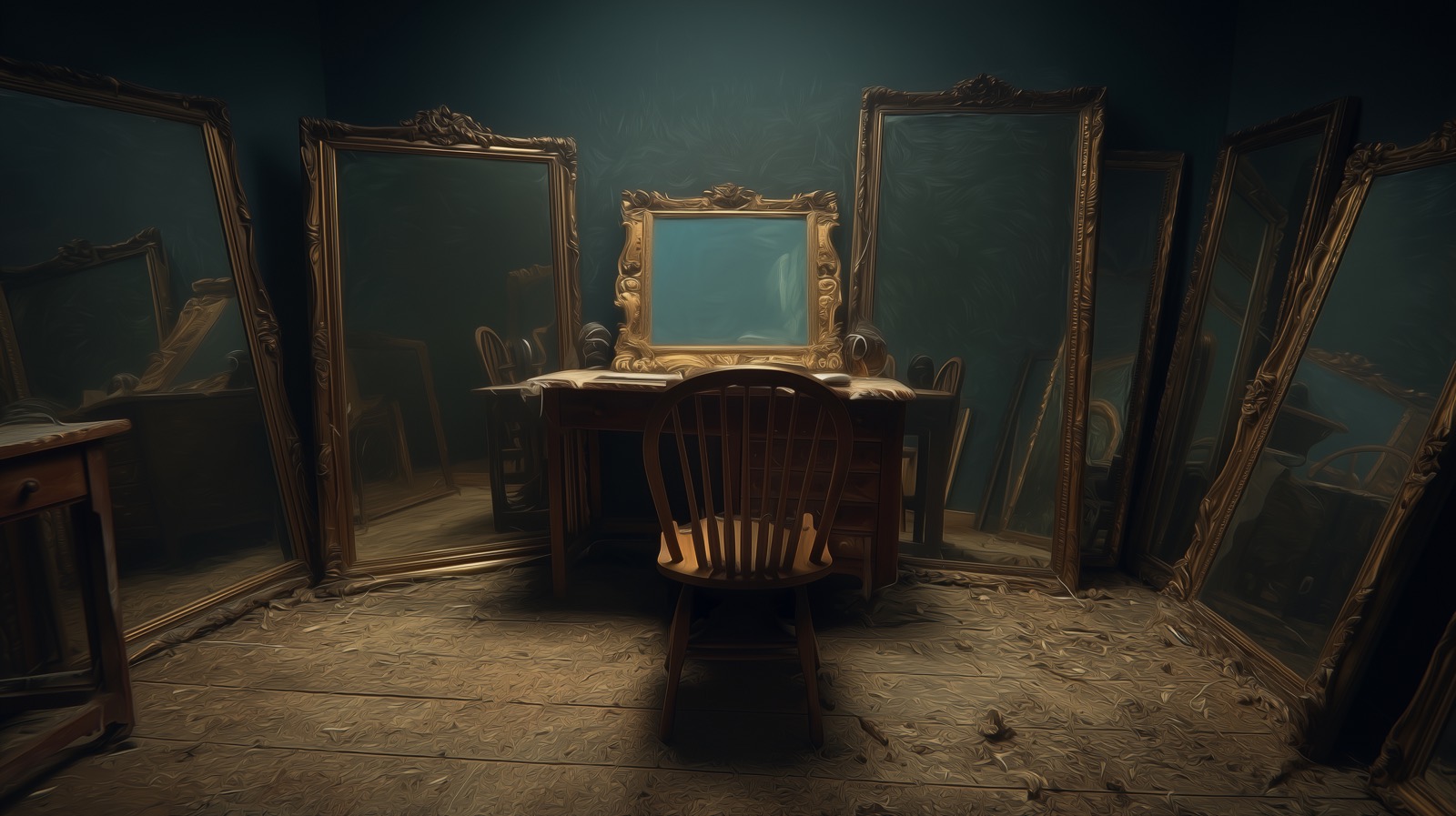
This reluctance to be vulnerable is itself a form of vanity — the vanity of wanting to preserve an idealized version of ourselves that may not even exist. We’re like those people who only post filtered photos on Instagram, except we’re filtering our entire existence.
Here’s an uncomfortable truth to sit with: What if the version of yourself you’re protecting doesn’t actually exist?
The deeper vanity (or: Ecclesiastes meets existential dread)
“Vanity of vanities, all is vanity.” I love this passage from Ecclesiastes. It touches me in a special way. Here, vanity isn’t referring to the more vulgar notion of thinking you’re better than you really are. It’s saying that we are made of emptiness. What we consider to be “ours” is a fiction we invent about ourselves.
Did you choose your beauty, your intelligence, your parents, your genetic heritage, your surrounding reality? No! There’s a raw reality that punctures the grand fantasy that we are creators of ourselves. We are products of contingency.
Life on Earth has existed for 4 billion years, and our culture is 2,000 years old. We have no notion of this perspective. We walk around thinking we’re the authors of our own stories when we’re really just characters in a much larger narrative we can barely comprehend.
Think about it: We’re essentially cosmic lottery winners who spend most of our time arguing about who deserves the prize. It’s like musical chords competing over which harmony is purest, forgetting the celestial music they create in silence
Ponder this cosmic joke: If everything you consider “yours” was just handed to you by chance, what exactly are you so proud of?

Finding peace in the void (and learning to laugh at ourselves)
This might sound depressing, but I find it liberating. If we’re all products of chance, if our achievements and failures are part of a cosmic lottery we never chose to enter, then maybe we can hold our accomplishments and our mistakes a little more lightly.
This doesn’t mean we stop trying or stop caring. It means we can create and critique and collaborate with less attachment to being right, less need to prove ourselves, less fear of being exposed as imperfect.
The designer in me is learning to present ideas with conviction but without desperation. The entrepreneur in me is learning to fight for the right ideas, not for being right. The human in me is learning that exposure — vulnerability — might be the only way to connect authentically with others.
Maybe the real challenge isn’t eliminating vanity but recognizing it, naming it, and laughing at its absurdity. After all, there’s something delightfully ridiculous about a bunch of cosmic accidents getting together to argue about who makes better presentations.
Final reflection: If we’re all just learning to be human for the first time, why not embrace the awkward beauty of that discovery?
After all, if everything is vanity, then the sooner we recognize that we are all chords in a symphony that transcends our understanding, the sooner we can surrender to the only music we know how to play: being authentically, imperfectly, beautifully human. And discover that our truest song emerges from the silence between the notes.
To continue the dialogue
Thank you for accompanying me in this reflection. This text is part of an ongoing investigation into design, AI, creativity and narrative that overflows into practice at my studio and in the tools I build. If these ideas resonated, I’d love to continue the conversation.
Where to find me: Pedro Brêtas and pedro@reinostudio.com
Projects: Reino Studio and Fale com Amia